
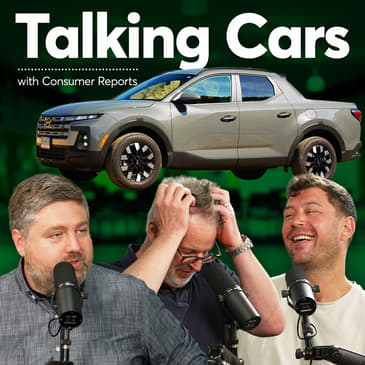
In this episode, we take an in-depth look at the 2026 Hyundai Santa Cruz, which, ironically, was officially discontinued days after we bought one for testing. We talk about the history and future of small trucks, discuss why Hyundai decided to end production of the Santa Cruz, and answer a question from a Santa Cruz owner about why the Santa Cruz returned low scores in our cargo capacity assessment.
SHOW NOTES:
0:00 - Introduction & Why We Bought Another Santa Cruz
1:03 - Why Hyundai discontinued the Santa Cruz
3:03 - Is a small truck enough for most people?
7:05 - What we dislike about the 2026 Hyundai Santa Cruz
13:35 - Best Small Truck Alternatives
19:50 - Audience Question: How Does CR Score the Bed Size of a truck?
27:15 - Audience Question Follow up: Favorite cars purchased by Ernie from North Carolina
LINKS:
2026 Hyundai Santa Cruz: https://www.consumerreports.org/cars/hyundai/santa-cruz/2026/overview/?EXTKEY=YSOCIAL_YT
Test Results: Ford Maverick: https://www.consumerreports.org/cars/ford/maverick/2026/overview/?EXTKEY=YSOCIAL_YT
Model History: Honda Ridgeline: https://www.consumerreports.org/cars/honda/ridgeline/?EXTKEY=YSOCIAL_YT
Test Results: Ford Maverick Hybrid: https://www.consumerreports.org/cars/ford/maverick-hybrid/2026/overview/?EXTKEY=YSOCIAL_YT
Test Results: Ford F-150 Hybrid: https://www.consumerreports.org/cars/ford/f-150-hybrid/2026/overview/?EXTKEY=YSOCIAL_YT
6 Most Reliable Used Pickup Trucks, According to Consumer Reports' Experts: https://www.consumerreports.org/cars/pickup-trucks/most-reliable-used-pickup-trucks-a7737894754/?EXTKEY=YSOCIAL_YT
[00:00:10] Welcome back to Talking Cars, I'm Michael Crossan. I'm Mike Quincy. And I'm Ryan Pizlokowski. So today we're going to be talking about the 2026 Hyundai Santa Cruz. We bought another one and we'll kind of get to that here in a minute, but it has completed all the CR testing and we thought we would talk about it. So we purchased this 2026 Santa Cruz SEL Activity all-wheel drive, quite the name, base price of $35,700 and has tested $38,680. That does include a destination charge
[00:00:38] of $1,600. Now, why did we buy another one so soon after we had our 2022? Well, the answer is this new powertrain. The previous one was a 2.5 liter turbo that made a whopping 281 horsepower and had a DSG transmission. This new one is a 2.5 non-turbo, makes 191 horsepower and has a pretty much a traditional automatic transmission. So because the drivetrain is so different, we figured it was worth buying. And then here's the thing we need to mention. About 10 days after we bought it, Hyundai canceled
[00:01:08] the Santa Cruz. Isn't that just like our timing? It's even funnier because, well, we'll talk about it, I guess. So we bought one and they canceled and they cited poor sales numbers and high dealer inventory against other smaller trucks like the Ford Maverick. So with that, and let's maybe shed some light on why this went away. Mike, what does the small truck market look like in terms of sales?
[00:01:33] Well, Hyundai wasn't wrong. I mean, the Santa Cruz sells a fraction of the number of the other small trucks. And when you take, you look at the leader like the Toyota Tacoma, which, you know, in a kind of good or normal month, we'll sell about 20,000 units a month. And the Santa Cruz would be lucky to sell 20,000 units in an entire year. So for the month of May, Hyundai sold approximately 375 Santa Cruises,
[00:02:01] if I can say that correctly. I think one of those was ours. Yeah. And while Toyota in that same period sold 23,814 units, these numbers are coming from the automotive news, the industry trade paper that we all know and love. Tacoma is not even fair to really compare it really. But it is sort of the juggernaut and it is that medium-sized truck.
[00:02:25] But I mean, you scale it back down to the size of the Maverick. The Maverick is still pulling around 16,000 units a month. That's a better comparison. And that's like still like way more, right? Right. And you think about it, I think I see more Subaru Bajas. Remember the Subaru Baja? Yeah. Every now and again, then I see a Santa Cruz. You rarely see Santa Cruises. I don't ever see them, I feel like. But maybe the question is, why did why did Subaru stop selling the Baja?
[00:02:51] Well, why did Hyundai stop selling Santa Cruz? That was a long time ago, right? I mean, I don't even know what year that was. Yeah, I don't know what their sales numbers were, but that was definitely a bit of a quirky kind of thing. Right. Just different take on the outback, I guess. But I think we'll sort of get into this small truck thing because we mentioned, you know, we threw the Tacoma in this list, but it is a larger size truck, but we're still not up to full size truck. But the Tacoma, the Colorado and the Ranger are, you know, quote unquote, let's call them real trucks, if you will, versus these other more unibody car based kind of things. The car trucks I call them.
[00:03:19] So ultimately, like how much truck is enough truck? And I guess that depends on the type of things that you do. You know, is you don't own a boat, Mike Quincy, luckily. I do not own a boat because I want financial solvency, but someone I know does. So like Mike, you don't have a need to tow a boat, but Ryan, you might have a need to tow a boat. So Yeah. I tow a lot of things, right. Yeah. And the boat's really not even the heavy thing. I mean, I have other stuff like an equipment trailer and a tractor and all this stuff. So that stuff heavier.
[00:03:45] But also like, I'm still working on a house and I need to go get like a bunch of eight foot sheets of sheet rock. Right. Like even a regular full half ton truck with the short bed is like, I have to leave the tailgate down. Not quite enough still. Kind of gently strap it and go home without, you know, too much fuss. But right. That's where I need like a real truck, you know, but I also look at it as, I mean, we have our vehicles here, so we don't need, you know, You can usually find a tow vehicle. You can. Yeah. Right. Right. But even if I had my own vehicle, I would have a full size truck and I would probably, it wouldn't get a lot of miles, but I need it when I need it. I need it. And I need a full size one.
[00:04:15] Absolutely. Probably a three quarter ton at times, you know, so. And you know, if you have a truck, you have a lot more friends. Oh, of course. Because your friends, your neighbors will always want to borrow their truck. Yeah, yeah, yeah. So, but a truck of this size, Santa Cruz, a Maverick, something like that might be enough truck for some people. Sure. For certain homeowners or maybe you live in a condo and you're not bringing home sheets of plywood. So, so in the Santa Cruz, what do we like about it?
[00:04:39] Well, I mean, the thing that we're criticizing about actually is also one of the more appealing aspects of it. It's size. It's very, it's very maneuverable. It's easy to park. Compared to the bigger trucks, it's certainly better on gas. So, so that. It's easy to drive. Yeah, it's easy to drive. It has kind of typically good Hyundai simple controls. The Bluetooth reconnects when you pair your phone.
[00:05:07] It's easy to get into. It has a decent ride, has pretty good handling. There's a lot to like about the truck. And it's, and it's not, it's not huge like an F-150. Sure. So, so it is pretty, pretty easy to live with. I mean, I, I like the idea of a small truck because I don't think most Americans need a full size truck. Well, I like it all for all the things that it's, it's not a truck. So it's easy to get inside. It's easy to drive. It's easy to maneuver in a parking lot.
[00:05:34] Um, Hyundai controls everything you just said, but, um, I, the truck part of it isn't, I don't like it. Cause that's not, it's not enough for me. In other words. Right. Right. There are people, I think this, it makes a ton of sense for a lot of people, especially when, you know, when this, this first came out, the Maverick, even the Ridgeline.
[00:05:48] I mean, that's sort of like the beginning of it for me, those make a ton of sense. There's quiet, they're nice to drive. Um, and it's just enough bed for most people. A lot of people drive around a full size truck. They do not need a full size. Empty all the time. Right. Right. Right. Exactly. So, so I think most people buy more utility than they ever use. Of course. Yeah. And a lot of these quad cab short bed trucks, a full size, it's like an SUV. It's a backseat. It's huge. They can do a lot with it. Um, but they probably really still don't need that much. Right. And the tows 10, 12,000 pounds, depending whatever it is. Um, they don't have towing that.
[00:06:17] You know, or, or, you know, how many times a year do they tow it? Yes. Or, you know, they go on a couple family vacations. But again, when you need it, you need it. Yeah. It's like, I don't know. The percentage is pretty small. Yeah. And, um, it's, it's sort of just, I think, sensible, right? It gives you a little bit more flexibility than an SUV might. You can put something tall in the back, like from the garden center. Yeah. Um, like the Baja would have been a good example for that. Or remember when the Trailblazer, but it wasn't the Trailblazer, it was the, the GMC, the, uh. It had the rollback thing. The strange envoy rollback thing. Yeah. It was like super heavy.
[00:06:47] It was heavy and awkward driving. Oh, yeah. It was on the extended wheelbase only. It was like an extra thousand pounds up in the air. But you could like put a tree in the back of it if you needed to. Yeah. I don't know if it was practical, but you could transport trees, I guess. And I don't think they sold a lot of them. No, no. You see one every now and again, but yeah, they didn't sell a lot of those. Yeah. So, um, so Ryan, what don't you like about this thing? Which I think I know, but let's hear it. Yeah. No, it's the, the powertrain in this is, um, it's weak.
[00:07:12] Oh. The transmission doesn't have the dual clutch issues that I did the first time around. Correct. But I would take those issues with that, that more, you know. Yeah. So, so the non-turbo is 191 horsepower. Yeah. Versus 281 on that turbo. Yeah. And it's a huge amount of power. And, and it, and just a huge difference in our driving experience. Yeah. And because of that, you, it's, when you, you know, you have to wind the motor out, it gets loud.
[00:07:34] The engine gets loud in there. It's just, um, a lot less pleasant. Um, because really that's a big issue for me when it comes to driving it as it, as it is, right. It's still just not big enough truck for me, but that's besides the point at this point. So, um, I think, yeah, we, we tested this thing. They tell us when they're getting rid of it and then it's not good on top of it. So it's like, this is a real sad way out. It's, it's, it's a, it's a real, it's a real double whammy for this, for the Santa Cruz. Yeah. And I will say too, on, on the truck side of things, um, it doesn't have the biggest bed shore. It's towing capacity.
[00:08:04] It's actually not terrible, but it is less with the non-turbo motor. So you take the hit on just your everyday driving, you know, merging and things like that, but then you can actually tow less with it too. Um, the non-turbo can tow 3,500 pounds, which is actually not terrible, um, when it comes to a smaller truck, but the turbo can tow 5,000 pounds. That's getting up to a much more useful kind of towing weight. Yeah. Um, whereas like Mavericks can tow 2,000 pounds. I mean, that's basically nothing. Um, and then, you know, if you need to step up to the
[00:08:34] Tomas over 6,000 pounds and the Ranger in Colorado, both can tow over 7,000 pounds. Um, so I think Maverick is that low. Yeah, it's, it's very low. Um, bed cargo, um, weight too. Like, you know, the onboard weight is pretty low as well. But, um, yeah, I, I think I'm with you guys on this. It's sort of a questionable thing. And the vehicle itself is a little questionable. Like why is it enough truck? But then they took away a bunch of power. Yeah. And I don't think we saw a real big difference in terms of like, um, fuel economy out of losing the turbo and losing all this power either.
[00:09:04] So, um, bit of a questionable choice. I think personally, I probably wouldn't buy one anyway. Um, I'm skipping ahead here a little bit, but definitely not in the non-turbo. Can I circle back to the engine? Absolutely. Okay. Cause it is, it is so underpowered. It's, it's almost scary. It's almost, it's almost, I'm not going to say unsafe, but it's, it's just horrible. And, and I was talking to, to Steph Schrader about this, you know, frequent, uh, guest on, on talking cars. And, and she said the car simply has no beans. She said it's the chili of
[00:09:34] cars. And I thought that was awesome because some people that like chili, like, Oh, there shouldn't be no beans in chili, but that's, you know, that's, well, if you're from Texas and I'm from Texas and no beans in chili. Um, but, but when you try to pass a car on the highway and I, and I experienced this myself, so I'm, I'm, I'm, I'm moving out into the left lane and I'm asking for power and I put my foot down and you're right, Ryan, it's noisy, but there's nothing there.
[00:09:56] You can, you can get a reaction. You can absolutely mat the accelerator pedal and it's going to, uh, and it doesn't, but it's not, it's, there's no more power to give. Correct. And it's going through now a traditional automatic. So that's soaking up some of that power as well. And it's just a little lazier in terms of shifting and the engine is screaming and it's not really moving. And so you can have some anxious moments. If you're, if you're, if you're thinking I'm going to, I'm going to dip into this well of power that you do in almost every single car.
[00:10:23] Yeah. And, and, and with the Santa Cruz, there's, there's no reserves. Right. And there's a lot to be said. I mean, that's, that's a real life, like real life situation. Yes. I mean, you're getting on the highway, especially like where they're doing work over here and there's a one lane you're merging into one lane. You better figure it out. And like that thing doesn't leave you a lot of room to figure it out. I think, I think people, people misinterpret when we talk about a car's, uh, a power that we just want to go out and, and, and drive like a hot rod. No. But in some ways you need a burst of power to get you out of a, of a, of a stickier.
[00:10:53] Yeah. Which could be dangerous. And it really is a safety thing. And I'm not, and I, I'm usually slightly sarcastic when I'm doing this, but I'm not being sarcastic here. And, and the advice to the talking cars audiences is just like, do not, if you're thinking about a Santa Cruz, do not get the base engine at all. I mean, you'd have to step up. You'd have to step up to the XRT or the limited, but now you're looking at, you know, 41 to $43,000 for a pretty small truck.
[00:11:20] Yeah. That's getting spendy. Yep. So, so that in our trim line, uh, you know, we're kind of hammering it here, but our trim line didn't have, um, adaptive cruise control, which like every Toyota Corolla has, it had, it had a plain plastic steering wheel, which I find so depressing. I mean, how, how much is it going to cost an auto manufacturer put some kind of a wrap on the steering wheel? Uh, I don't know. It's, it's, it was a weird combination of, there's some value there, but they also took out all this other stuff.
[00:11:50] So interesting question. Do you think maybe they knew that it was on the chopping block when they sort of, they had some parts back this and out, let's just kind of get these out, get these out of here. Maybe. I mean, I'm, I don't know. They build a lot of parts for these things way ahead and because the body's the same, right? Like a lot of that stuff's the same. And there's gonna be a lot of shared parts too with, um, like the Tucson and things like that. Right. And you know, a lot of this, they just have this stuff on shelves. Yeah. And they knew the motor wasn't great in the first place. I don't know.
[00:12:17] It's just fine. I'm looking at my notes and like the, the, the, the, the reason to like it is, is it's not huge like an F-150. And the reason not to like it is it's not huge like an F-150. So I guess, um, that being said real quick, driving around town, it isn't horrible. Like regular old urban driving. It's not bad. Um, but just like the merging thing. I mean, imagine if you had, you were driving by yourself likely. There was, yeah, there was, there was nobody but me. I didn't have, had nothing in the bed.
[00:12:46] Put some stuff in the bed and maybe two or three people. That's the thing. That's yeah. Yeah. When we do fuel economy testing, it's on the track and it's, um, it's a bit of an aggressive sort of course, if you will, for, for city driving. And it did have enough power to do that. And Ryan, you've done a bunch of fuels driving. You know, some of the, the, the bursts of Excel, some vehicles are like, I'm not sure I'm going to make it. Your foot's practically to the floor. And that wasn't really the case in this.
[00:13:08] It had enough to do that, but it's the right circumstance, maybe an uphill merge, you know, you're at a 40 roll already and you need to get up to 65 or 70, you know, to, to get yourself out of those situations. Um, yeah, I would say, you know, if you're interested in one of these, definitely drive a couple of different trim levels and make a call from there. But, you know, just don't go for the one they have on the line. If you're buying the base engine, you need to get a bumper sticker that says I'm pedaling as fast as I can because people are going to be coming up behind.
[00:13:35] You're like, why aren't you moving? But so like it comes down to it. If you want a pickup truck, not a huge one. Yeah. What do you buy? Me, I buy a Ridgeline, but the Ridgeline is a little bigger kind of Maverick. These are all weird because they're not like almost apples to apples. They're, they're car. But we're talking, you know, you know, less than a half ton pickup truck. Yeah, I buy a Ridgeline. Okay. Yourself? I was going to preface this with all kinds of stuff, but if I just want a small truck, a Maverick, it does a lot of the truck things that I need.
[00:14:04] I think it's a better driving experience in general. And when I do need a bigger truck, personally, I can usually get one here or, um, I may have rented a truck just to go do truck things that I need to, because I don't need to have one all the time. But if I did have to do a lot of that stuff, I would just bite the bullet and buy a full size truck and deal with the negatives that come along with that. We hard to park poor fuel economy, you know, because you do need it when you need it. As you know, Ryan has said a couple of times. So, um, but as far as a little one goes Maverick, probably the all wheel drive hybrid.
[00:14:32] I was going to say, I'll see your Maverick and raise you a hybrid. Um, that's, that's definitely the one that I would go for mainly because it has such good fuel economy, a great cruising range, um, and enough utility where. Yeah. What the projects that I'm going to be working on my house aren't going to require something, something big or heavy. But I also will preface this by saying that last Ford F, F one 50 hybrid truck that we had phenomenal.
[00:14:58] I mean, a great ride, just like the Ram 1500. Uh, if you want something comfortable to drive in, in like a truck, you really have to go up to, to, to one of the bigger models. But, but I'm, I, I'm, I'm, I'm a huge advocate of, of smaller trucks. And so I guess I was kind of a little sad to hear that this, that one of the small truck options in the United States is not that many. It's going away. Yeah. So that's too, that's kind of too bad. And I don't think Chevy's bringing back the El Camino anytime soon. Unfortunately. My dad had a Ranchero, Ford Ranchero.
[00:15:29] And I think back on like, that was like a pretty much a body on frame. Yeah. Car with a bed. Only one, you know, single cab. It wasn't a, you know, had a Hearst T like T handle. Yeah. A four. I can remember going to three 51. Yeah. Yeah. I can remember going to the dump at pace because this thing was scoot right along and it was like the dump car, but it was like, it had a steel tailgate and it was like, it was all metal. Everything. Yeah. It was robust. You could use it. Yeah. I mean, it was a truck, but just cut that like flat, you know, car.
[00:15:58] And it was, it was, it was awesome. But think about the thing about those meetings in Detroit, you know, those many decades ago where the executive was like, okay, okay. I got an idea. I got an idea. Wait, wait, wait, wait. So we're going to take a car and, and we're going to like get rid of the backseat and forget the truck. We're going to take a car and we're going to merge it with a truck. What do you think? And everyone laughed and laughed and laughed and laughed. I think there was a lot of. And then, and then they all sold them.
[00:16:23] I think there's a lot of cigarette smoke in the air and probably like, um, like those cut glasses on the table at the time that those decisions were made. Waterford Crystal. Yes, exactly. You know, this is the heyday of Detroit. And, and, and Chrysler put out their own kind of front wheel drive version called the Rampage. I don't know if you remember that. I remember that. I remember hearing about it. It was K car based along with all the other. It was like, it was like based on the Omni and the, and the, and the, the GLH and all that. Not in the GLH, but, but yeah.
[00:16:49] So a front wheel drive, small truck Volkswagen had a rabbit, uh, truck. And, and what's kind of weird about that, the dynamics of, so it's, it's, it's front wheel drive, front engine, obviously. And then you put weight in the bed. Yeah. So, so, so you, so you're actually taking traction away from, from the front end of the car. So now it's a hot rodders vehicle. Right.
[00:17:11] So, so, so the, the, the wheels that are doing the steering and powering it have, you know, it's, it's being out, outweighed by what you put in the bed. Just rolling out or not. So maybe, you know. I mean, I don't know if they're collectible. I'm not just going to get it physics, but I don't think that's a good, that's a good setup. No, it's not good. They, people like buying, if you can find a clean one. Especially Ranchero or El Camino. Yeah. Oh, those absolutely. But those rabbit, the rabbit trucks, I mean, what did they call them? Something else I thought. I think it was a rabbit truck. I don't know. There was another name that I think people call them.
[00:17:41] Yeah. Talk about slow. Oh God. That actually would be slower than, than our, our, our Santa Cruz. I think it would be. Yeah. So I don't think any of us would have bought the Santa Cruz. I don't think other than just lamenting the loss of a small truck. We're not really sad about it either. I'm a little sad about it. But I mean, it doesn't, it doesn't make it a terrible vehicle. And certainly if it's turbocharged, better option. Yeah. Like, yeah. I'm not saying this isn't for somebody. Yeah. Correct.
[00:18:07] You think you could get a real, just a smoking deal on one right now on the, on the dealer lots? Cause they're, I mean, I don't think it hurts. I bet you could beat them up. They probably want to move these things. They probably have some incentives from Hyundai to get them off the lots as well. I would think. Maybe it's something to consider. Yeah. More on that later. All right. So, so we tested it and we've put the ratings on it. And so it's through the test program. I don't know if the ratings are actually live on the website yet, but if they're not today,
[00:18:37] they will be pretty soon. So you can kind of cross shop that and compare it with any of the other small trucks or SUVs that buyers might want to buy. And of course that stuff is there forever because these cars do exist and they will be out there as used cars. Yeah. Yeah, exactly. And we'll be able to track the reliability and all those kinds of things. But second owner, third owner can still use all of our hard work that we put in for this car that was canceled and kind of from a tester's point of view, I was out there sweating doing fuel economy testing. It's like, I don't even make these things anymore. Why am I doing it? It's still useful, right? There's data for historical purposes.
[00:19:07] And there's still probably thousands and thousands of these out there that people can buy and get a deal on. You actually get a good deal on it. Yeah. It certainly doesn't hurt to ask. I think we can determine that this is not a horrible vehicle. It's not the worst thing we've ever driven. It does have some utility. Yeah. But when it comes to how does it rank among other small trucks, the interpretive thing that I've always told people and what I've said many times is there are better options out there. And that's the case here.
[00:19:37] So without letting the clue out of the bag here. Yeah, absolutely. So I think this is actually a pretty good transition to our question from the audience. We love to hear from the audience and they can send written questions or video questions to TalkingCarsAtiCloud.com. And if Dave Abrams picks your question and we or whoever talks about the podcast, you will get a shirt, a Consumer Reports Auto Test Center shirt or a hat or whatever Dave has available. He will send out. But Ernie in St. James, North Carolina out on the coast actually did like the Santa Cruz
[00:20:06] and purchased one. But his question is regarding the Santa Cruz. Now that the Hyundai Santa Cruz has been available for years, have they made significant improvements that might raise the overall score CR gives it? I noticed your score dings them on the small bed. You shouldn't do that because people that buy this car are fully aware of the small bed and like me purchase the truck because we don't need an average size bed. That could be the same as digging a large truck because the bed is too big. It all depends on the use for the truck.
[00:20:33] I can't imagine someone buying this truck and then discovering that the bed is too small and then complaining. P.S. I've used your car ratings reports as a main factor in deciding what car to buy over the past 40 years. Purchases have included 1976 Toyota Celica, 1979 Buick Arrigo Limited, 1985 Chrysler Minivan,
[00:20:53] 1995 Nissan Maxima, 2002 Toyota RAV4, 2008 Toyota RAV4, 2006 Toyota Camry Hybrid, 2021 Mazda CX-5 Turbo, and now the 2025 Hyundai Santa Cruz Limited. So Ernie, thank you for the question. Awesome question. We're always kind of happy to help maybe shed some light on these kinds of questions. A loyal reader and watcher. Absolutely. And car buying expert rivaling Mike Quincy, I think, for the number of cars purchased.
[00:21:21] So Mike, I'm going to ask you, Ernie brought up this bed size thing, saying that we're dinging it. But really, how does bed size equate to our rating system when it comes to a truck? Well, bed size does have a factor. Larger bed will score better. But we don't penalize a vehicle for having a smaller bed. We just report kind of what it is. We want to help you manage expectations. I mean, one of the interesting things he said in his question was that people buy this, know that it's a small bed.
[00:21:49] Well, I don't think at Consumer Reports, we assume anything. You know, we don't assume that people know, you know, what they're getting because they might not even have gone out on a test drive yet. So I would say that's a safe assumption. Well, right. But it's kind of like, well, we talk about, I know I'm going off in a different lane here, but like the Jeep Wrangler is a vehicle that has a ton of character and a lot of people like it. But we would be remiss by saying the ride is pretty bad.
[00:22:19] It's stiff. It's noisy. And there are compromises if this is going to be your day to day vehicle. Now, you could say, well, everyone knows that the Wranglers, not everyone knows. Not everyone does know that. So I reporting what we find. I would say to Ernie, you're probably among the more educated consumers out there, obviously, when you're talking about all the vehicles we helped you buy. But not everyone knows everything that cargo capacity of all vehicles is something that we test. Right. Right. We measure the beds. We went every SUV.
[00:22:49] We do this expandable pipe frame box where we measure the volume. We do this all on our ratings on ConsumerReports.org. But we do measure it. So we don't put it down for having a small bed. But we will report to readers, subscribers, and members of whatnot that it is a lot small to manage your expectations. If you think, well, I'm buying a pickup truck, this is a pretty small pickup truck. Yeah.
[00:23:18] So how small is this actual bed? How does it stack up compared to all the other smaller trucks? So you've got some numbers here for me. So the Santa Cruz has 15.9 cubic feet of room in it. The next competitor, the close competitor, the Maverick, has 26.1. That's a big jump. There's several difference, right? Sure. And then you go to the Ridgeline, it's 27.9. That's a decent-sized bed. The Maverick, which is the closest competitor, is still much bigger, 26.1 compared to the
[00:23:47] 15.9. So that's where those points come from. Yeah. And we're not penalizing it from having a small bed. It's scoring some points. It's just not scoring all of the points. Right. And if they made, let's say, a long bed version of the Santa Cruz, that one would score more because you can put more stuff in the bed. Sure. I think one of the things that we're always trying to emphasize here at Consumer Reports is that every vehicle has compromises. I mean, everyone. You have to give up something to get something and whatnot.
[00:24:17] And Santa Cruz's nice maneuverability and easy to park is one of the things that's really nice about it, but you're giving up big bed size. And I think something, too, we should talk about is Santa Cruz has a tonneau cover, like a hard tonneau cover, which is great because you can put stuff in and it keeps out of the weather. It keeps it secure. You know, if you stop at a restaurant, you got some stuff in the back, that sort of thing. But just sort of its functionality.
[00:24:42] It takes up probably six to eight inches of the front of the bed, like when it's fully retracted. Rolled in, yeah. So you have all this room underneath it. It's kind of like a shelf that just sort of gets in the way. Whereas some of these other vehicles have more of a, I'll call it more of a traditional tonneau cover as an accessory, like a soft one or a hard tonneau cover that lifts up with a set of hinges and struts and things like that. It also has a unique system in it for kind of tying down cargo. And it came with like some crossbars. We took those out for, you know, when we do cargo testing, we don't want them knocking
[00:25:12] around in the back wall. Ryan's out there doing track handling and things. But there's a rail back there that has these threaded inserts. You can make all these adjustments. And have you heard driving around? There's actually a clunking in the back of it. Oh, I was just going to say, I've definitely heard that as well. So those are the little threaded inserts in the rail. There's some extra knobs and we've been able to restrict their movement because if not, they slide the whole way, but they still move a couple of inches. And that's that metal clanking you hear as you're driving around. So, I mean, you know, there's you got to put the rails back in or the cross rails back
[00:25:41] in or come up with another solution, maybe another threaded knob that can hold that that insert in place. But it's something that I found annoying driving and testing it. Just you hear this thing clanking away. I thought there was something wrong with our truck. So I was like, oh, wow, something's broken back. Yeah, but I mean, the terms of just the infrastructure that give you back there does seem very useful in terms of making the most out of space and tying things down. And so things can be secure and stuff like that. I do appreciate having like all the little tie down different places to tie stuff down to.
[00:26:09] I mean, we don't want to discourage manufacturers from putting in these, you know, thoughtful features. I mean, somebody looked at the design of this and said, well, what if we did this in the back? How can we make it better? That. Yeah. And, you know, we applaud that. Because a lot of old trucks had nothing. Oh, sure. Or there might be just like a welded loop, like one in every corner. And they weren't the most useful thing. So this is adjustable because, you know, the stuff that you might carry is going to be different than what you carry, Ryan. So I think it's great.
[00:26:35] I just think they missed a little bit here in the not using it department. Like it's great when you use it. But what about when you're not using it? And I hope other manufacturers don't look at this and say, well, we shouldn't bother designing small trucks because I want some small trucks to keep coming. I mean, the slate's coming out. You've got to do better. Yes. Which is the smallest of the small trucks, I think. Of course, it's electric. And we'll see how that goes. We haven't got our hands on one yet, but we will eventually. We are planning a purchase. We'll be buying one.
[00:27:04] And then hopefully we can just get a clean slate from all this truck talk. So I want to thank you for your first question. Abram's glaring at me right now. I can feel it on the back of my head. The laser beam. But I actually have a question, a follow-up question of Ernie's question. Of all of these cars that Ernie has purchased with the help of Consumer Reports, what are our favorites? What do you guys like? I was hoping you were going to bring that up. He's only asking this because there's one in there that he loves. Well, there's probably. I know there's one in there that I love, so I'm hoping there's one in there that you love. Yeah.
[00:27:34] It's none of the old ones, though. It's probably that Monster CX-5 Turbo. That was a great car. You're not wrong. It was a good car. Yeah. All right. So, Mike, what's yours? Oh, it's the 76 Celica. Absolutely. My mom had a 78. It was still rear-wheel drive. It had a five-speed manual. Back in the 70s, there were just a lot of four speeds. So, a five-speed seemed pretty exotic. This was also the first Japanese car in my family's household.
[00:28:02] And we were all amazed that nothing broke on it. I mean, it just ran and ran. Probably still running today. It started up every morning. And we thought, wow, because we bought cars from Detroit the whole time. And actually, my dad did have one BMW in 2002, which you would have loved, by the way. It was like a 73 or something like that. That car's probably a return to the earth. Yeah, really? In form of rust at this point.
[00:28:29] I have a great fondness for all the rear-wheel drive Celicas of that era. And I would love to find one in my later years. And which one grabbed you? Well, clearly, the 1979 Buick Regal. I could just see him driving it right now. The G-Bodies are fantastic. Workhorses, tanks, and stylish as well, I think. And another car that probably has rotted back into the earth, unfortunately. Could you have gotten it with a T-top, though?
[00:28:59] In 79, I don't think so. Okay. I had to go a little later for that. I'm not a G-Body expert, though. I'll leave that one to my brother. Now, the G-Body, that was also, if I get this right, like the Oldsmobile Cutlass? Cutlass, Monte Carlo. Yeah, all of those. And the Cutlass, at one time, was the biggest selling car. So, non-G-Body. Before, it was a G-Body. So, 1977, the Cutlass was the best-selling car in America. I actually owned a 77 Cutlass, which is why I know that useless fact.
[00:29:25] And for another useless fact, the 79 Buick Regal is a G-Body, which the El Camino was a G-Body as well. And we're back to El Camino. I was so happy when Ryan brought up the El Camino earlier. I'm like, I know where I can take this. Ranchero. Yeah, same thing. Yeah, they're pretty much the same. So, anybody have anything else? Or is that going to do it for us? No, just bring on more rear-wheel drive Toyotas. Unfortunately, though, Santa Cruz is not going out on a bang. But what are you going to do? Yeah, I mean, you know, and again, people might get some deals on them.
[00:29:53] And we're still going to live with ours for a while because it just exited the testing program now, which is kind of in the fleet. So, we're going to put our families in them and use them and things like that. And if history is any indication, everyone that works here at Consumer Reports Test Track, we use trucks all the time. Sure. You know, when we finally decide to sell our test vehicles, I'm always looking at the miles that they accumulate. And the trucks always have a lot of miles.
[00:30:21] Nowadays, I mean, they're getting pulled because we're going over too many miles. So, you need to get some money back on these things. So, if we let the mileage go too high, it's no good. And the trucks are always first culprit, always. In the springtime, you can't get one because everyone's buying mulch and doing those sorts of things. So, you know, they're certainly useful. There's no argument to that, whether it's a small truck or a big truck. And it's probably the most frequently asked question that I've received over 25 years here at the track is, what do you do with your test cars when you're done testing them? We just park them in the field out back.
[00:30:51] Well, you know, we're out in the country, but not that far out in the country. And the answer is, we put them up for sale for the people that work for Consumer Reports. Or we trade them in on new test cars. But, yeah, we do try to get some of our investment back. Yeah, we want to get the money back so we can keep buying cars. Right. And along with that, if you're watching on YouTube, you might see there's a fundraiser icon. And what that is, is a place, if you're watching and you want to help Consumer Reports do what we do, we are a nonprofit. We don't take money from sponsors and things like that.
[00:31:20] So, and cars are expensive. So, we do our best and we try to get our money back on it. But if a viewer wants to help us out, they can use that fundraiser button and help contribute to the cause. And, as always, I just want to thank everybody for watching. Check the show notes for links and articles and all that kind of stuff back to the website. It's always very useful. I want to thank Dave Abrams for producing the episode. For putting up with us. And it was shot and edited by Andrew Belise and Anatoly Shumsky. And also, I want to mention, Dave just was on vacation forever.
[00:31:50] Dave runs the comments for the YouTube on Talking Cars, at least all the car stuff. And they all have to be on approval, right? Because Dave keeps out all the terrible comments. Not all of them. He let some of them through. But I want to ask the viewer, you know, how much truck is enough? How much truck is enough for people? And that way it will give Dave extra work to do because he'll have to read all these comments and approve them on YouTube. So, let's fill that comment section and give Dave something to do. He's over there laughing hysterically. The future of podcast hosting right there.
[00:32:18] I just want to keep Dave busy because he keeps me busy. So, it's fair. This might be the worst episode, but... It could be, yeah. I always think that. He's never going to ask me to do this again. So, I think that's it. I want to thank everybody for hanging out with us and we will see you again next week.